
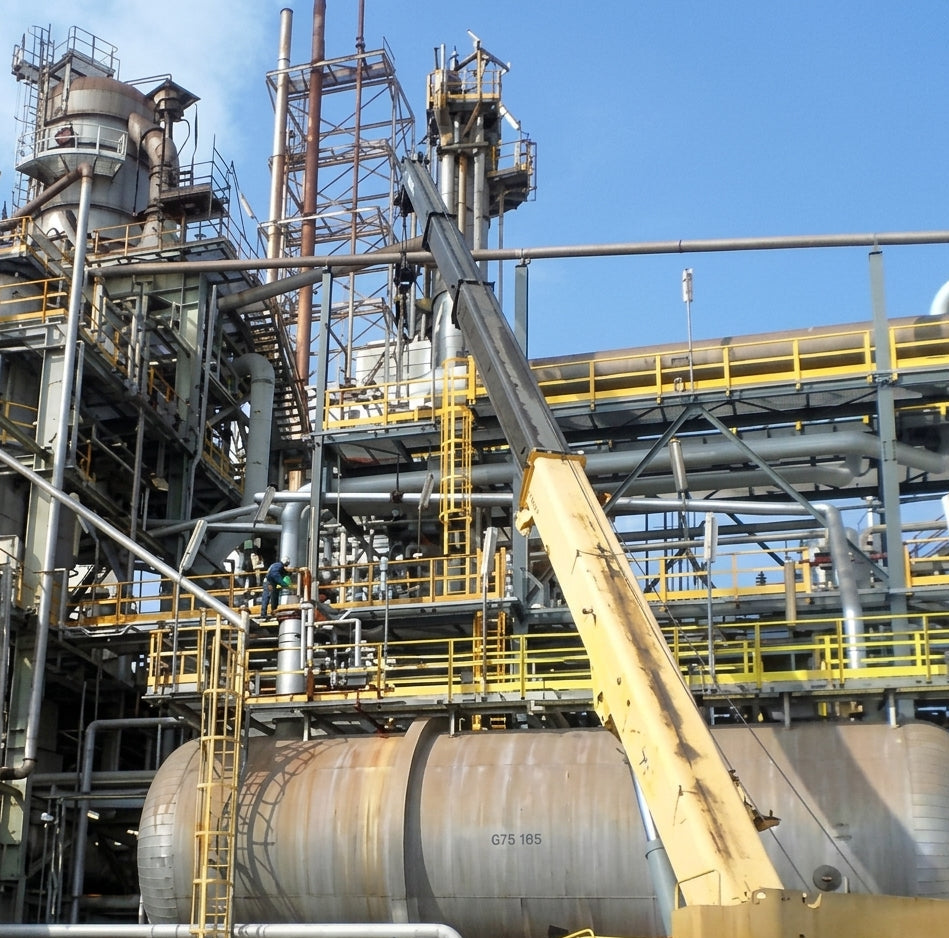
The context: the heart that powers the complex
In a petrochemical complex, Industrial Services produces and distributes what all plants need to operate: water, steam, electricity, compressed air, and effluent treatment. Together with the pumping station, it sustains the operational reliability of the entire complex. That is why its maintenance allows no room for improvisation: every intervention must be carried out on time, with the right equipment, by certified personnel, and without compromising operations.
What Is at Stake
A failure in industrial services does not affect a single plant, but all those that depend on them, and an unscheduled outage can shut down several process units at once. Added to this are the risks inherent in maintenance at this type of facility: heavy lifting, working at heights, high-pressure hydroblasting, and waste handling, which, without proper control, could contaminate the complex's drying lagoons. A contractor lacking responsiveness or operational discipline would turn each of these tasks into a risk to business continuity.
The Challenge
The client required a single contractor with immediate responsiveness, under strict operational conditions, to meet requirements of various kinds:
- Heavy and specialized equipment: 60 t telescopic cranes, 10 t knuckle boom trucks, 10,000 L (approx. 63 bbl) tanker trucks, high-capacity vacuum trucks (vacuum greater than 26 inHg and flow rate of 60 m³/h), 10,000 lpm hydro-blasting equipment, 66-foot (approx. 20 m) manlifts, and scaffolding services of up to 350 m³/day.
- Metalworking fabrication: procurement, fabrication, and assembly of up to 35,000 kg (35 t) of carbon steel structures, with surface preparation by abrasive blasting (sandblasting) to commercial grade, according to the SSPC-SP 6 standard.
The contractual conditions were demanding:
- Any equipment with failures or leaks had to be replaced within a maximum of 12 hours, and within 24 hours in the event of a major breakdown.
- Crane, platform, and knuckle boom truck operators had to have valid certification for each activity according to the COVENIN 3188 and 3132 and FONDONORMA 3175 standards. Lifting equipment had to have its load test certificate up to date.
- Each work front required an SIAHO inspector.
- Vacuum trucks had to enter free of any trace of hydrocarbons.
- Fuel, lubricants, and consumables were the responsibility of the contractor.
The solution
We organized the service into four specialized crews, each with its own foreman and SIAHO inspector, to ensure operational and personnel reliability at every work front:
- Static mechanics: first- and second-class mechanics to service plant equipment and structures.
- Electrical and instrumentation: personnel with certified tools for low- and medium-voltage work.
- Fabrication and welding: certified welder, fabricator, and helper, with 400 A welding machines, oxy-cutting equipment, and argon welding equipment (TIG).
- General services: cross-disciplinary support for all areas.
These crews were joined by a fleet of heavy equipment with certified operators, working 12-hour shifts. Each piece of equipment was inspected upon entering the complex, during operation, and upon exit. This provided the client with a single point of contact for load lifting, industrial cleaning, work at height, electromechanical maintenance, and fabrication.
Execution: the goals we set
We work with operational discipline and under the client's occupational health regime, with measurable goals from day one:
- Replacement time for equipment with failure or leaks: ≤ 12 h per breakdown
- Equipment and operators with valid certification upon entry: 100 %
- Work fronts with an assigned SIAHO inspector: 100 %
- Equipment inspection (entry, operation, and exit): 100 %
- Vacuum trucks free of hydrocarbon traces upon entry: 100 %
- Equipment fleet availability: ≥ 95 %
- Unscheduled downtime attributable to the contractor: 0
- Supply of fuel, lubricants, and consumables without depending on the client: 100 %
The results
With a single comprehensive contractor, the complex maintained its industrial services and pumping station with timely response, certified personnel, and continuous safety and environmental monitoring.
- Work items completed: 100% completed
- Structures fabricated and installed: 30 tons
- Actual average equipment replacement time: 10 hours
- Man-hours worked without lost-time accidents: 4,000
- Environmental stream management: 100%
- Schedule compliance: 95%
Does your plant need a partner that combines reliable equipment and personnel in a single service? Let's talk.